


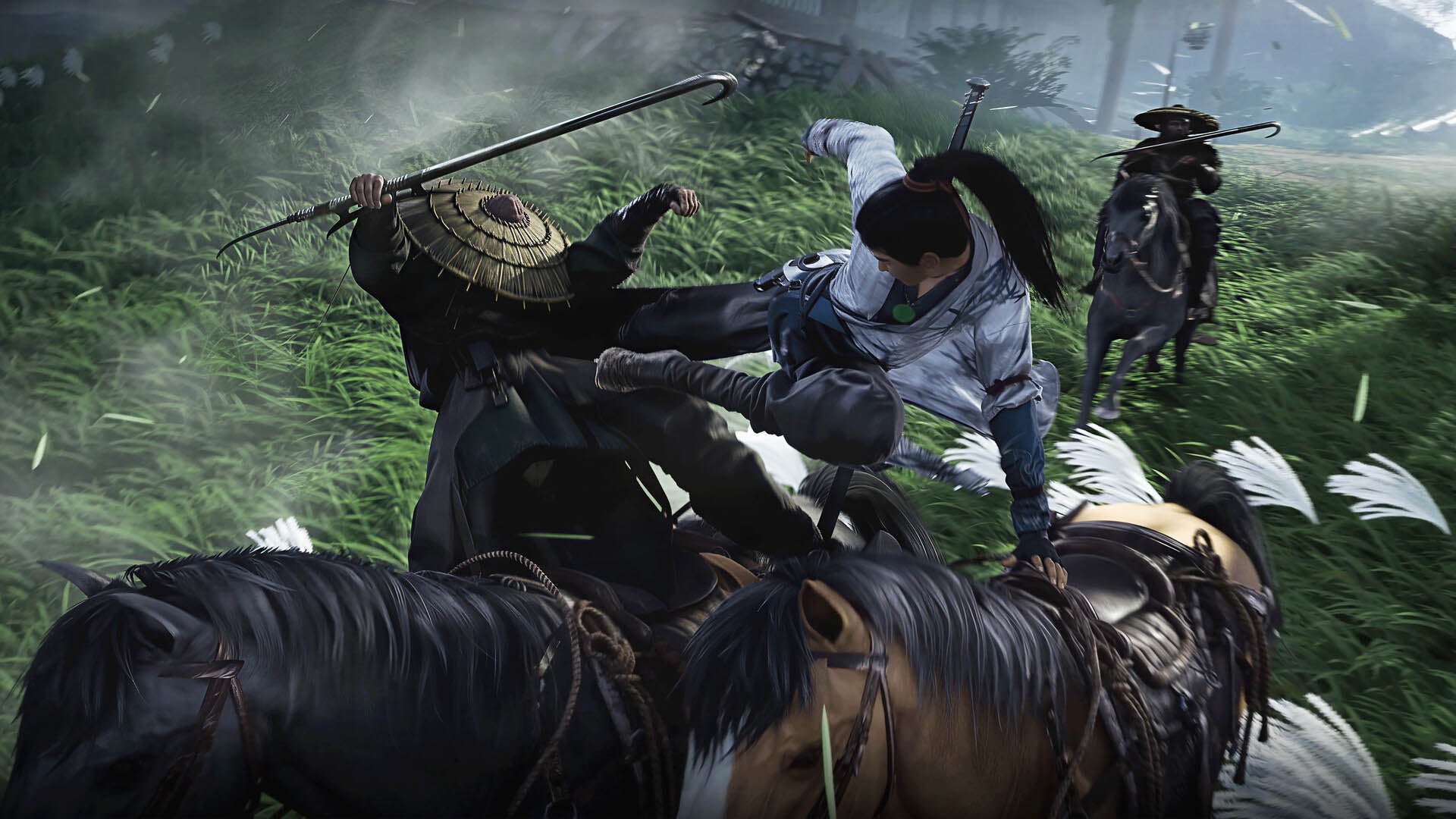
This yr, generative AI seeped into mainstream gaming. Although it did not a lot shimmer, as smear. It mispronounced traces in Arc Raiders, “drew” a smudgy loading display screen in Anno 117, voiced a sweary Darth Vader in Fortnite – maybe its least delicate look was in The place Winds Meet, the wuxia-themed open-world RPG that plugged a few of its minor NPCs into AI chatbots. The outcomes had been predictably beige and typically absurd.
I used to be heartened, as I typically am, by RPS’ feedback part, which largely dismissed the idea of an “in-game Siri”. Essentially the most-liked response summed it up: “I feel that utilizing a sport to work together with chatbots as an alternative of experiencing a home made story written by a dwelling particular person is idiotic.”
However a section of gamers and of RPS readers did like the thought. One commenter on Reddit mentioned it creates NPCs that “you’ll be able to actually work together with, you’ll be able to’t obtain this with out AI”. The place Winds Meet continues to peak at greater than 100,000 each day gamers.
I can not think about a 2026 the place we do not see extra in-game chatbots. GenAI’s dribbling into each crevice of our lives, together with the artwork we take pleasure in, seems uninterruptible – or a minimum of, uninterrupted. Extra is coming. Certainly, as 2025 attracts to a detailed, Larian founder Swen Vinke revealed the studio is utilizing generative AI in pre-production of Divinity, its first new sport since Baldur’s Gate 3. The information precipitated such a stink that he is dedicated to an open Q&A within the new yr.
With that considered the approaching wave of AI use in sport narrative in thoughts, I contacted 5 specialists to get their perspective: two AI researchers and three narrative designers. I needed to know if there’s one thing I am lacking. Might future AI chatbots, extra fastidiously prompted and constrained, improve a sport’s world? Does this expertise open any doorways? How will it evolve? And the way ought to story-driven studios reply?
For Meghna Jayanth, author and narrative designer recognized for 80 Days, Thirsty Suitors and Sable, the chatbot in The place Winds Meet sounds “each horrible and boring” and LLM chatbots are “the least fascinating, most resource-hungry, most corporately managed model” of procedurality and era, a subject video games narrative has pioneered.
“I made one thing for you, with out even realizing you. You, in enjoying, studying, listening, experiencing, know part of my humanity with out realizing me.”
– Meghna Jayanth
Chatbots are toys with “novelty worth” for some gamers – however the reality they’ll reply something is “extra of an obstacle than a bonus”, Jayanth says. Video games usually are not about giving gamers as a lot company as doable, they’re “about designing company in pleasurable or thematically fascinating methods”, she explains.
“What the participant can not do, what the participant can not say, what the sport says and leaves unsaid, these limitations convey what the story and the world imply to the participant. What the chatbot says or does not say will not be intentional,” she says. And for Jayanth, human connection is intrinsic to artwork: “I made one thing for you, with out even realizing you. You, in enjoying, studying, listening, experiencing, know part of my humanity with out realizing me.”
For these causes, “I do not see a real place for the LLM chatbot in fiction, aside from some particular circumstances the place the affordances and failures of the expertise are a part of the narrative or thematic conceit,” she says.
And that is all earlier than you think about the myriad moral issues she describes with AI and LLMs: the local weather influence of knowledge centres; the privateness risks of “sharing intimate particulars of your life with a corporately-controlled chatbot”; creators having LLMs educated on their writing with out being paid after which watching LLMs exchange their work; and chatbots hallucinating actuality, “driving us additional away from fact at a time the place the knowledge panorama is hopelessly fragmented, polluted, politicised and delusional”.
“I feel the query is so simple as: will we wish to reside in an alive world, or a useless one?” she asks.
“We’re all determined for extra connection, with nature, with one another, with life itself. We’re more and more atomised, overworked, underemployed, choked by poisonous air, susceptible to floods, earthquakes, heatwaves, whereas billionaires and elites devour the planet for revenue and depart us to reside within the wreckage. And their answer to all of that is for us to look deeper into the machine-vortex for friendship, validation and connection, reasonably than one another.”
Max Kreminski, an assistant professor of Design Tech at Cornell Tech college, questions the suitability of the expertise itself, saying that LLM-based chatbots will not are inclined to make good NPCs. They’re too unoriginal to provide you with novel concepts in a dialog, and too uncontrollable to do what a story designer may need. “In consequence, they have a tendency to scrub out the sturdy authorial intent that characterises actually good narrative design, whereas additionally not likely giving the participant a lot to ‘work with’ if seen as an open-ended improv associate,” they clarify.
Kreminski – who till lately led the Storytelling Lab at Midjourney, which makes AI fashions and is understood finest for its picture generator – believes builders are “awkwardly wedging [genAI] into contexts the place it does not actually match”, notably in standard, confirmed genres. “On high of that, present-day executive-level curiosity appears to be principally pushed by a need to chop manufacturing prices… despite the fact that pursuing this technique just about all the time makes the ensuing video games weaker.”
“Current-day executive-level curiosity appears to be principally pushed by a need to chop manufacturing prices… despite the fact that pursuing this technique just about all the time makes the ensuing video games weaker.”
– Max Kreminski
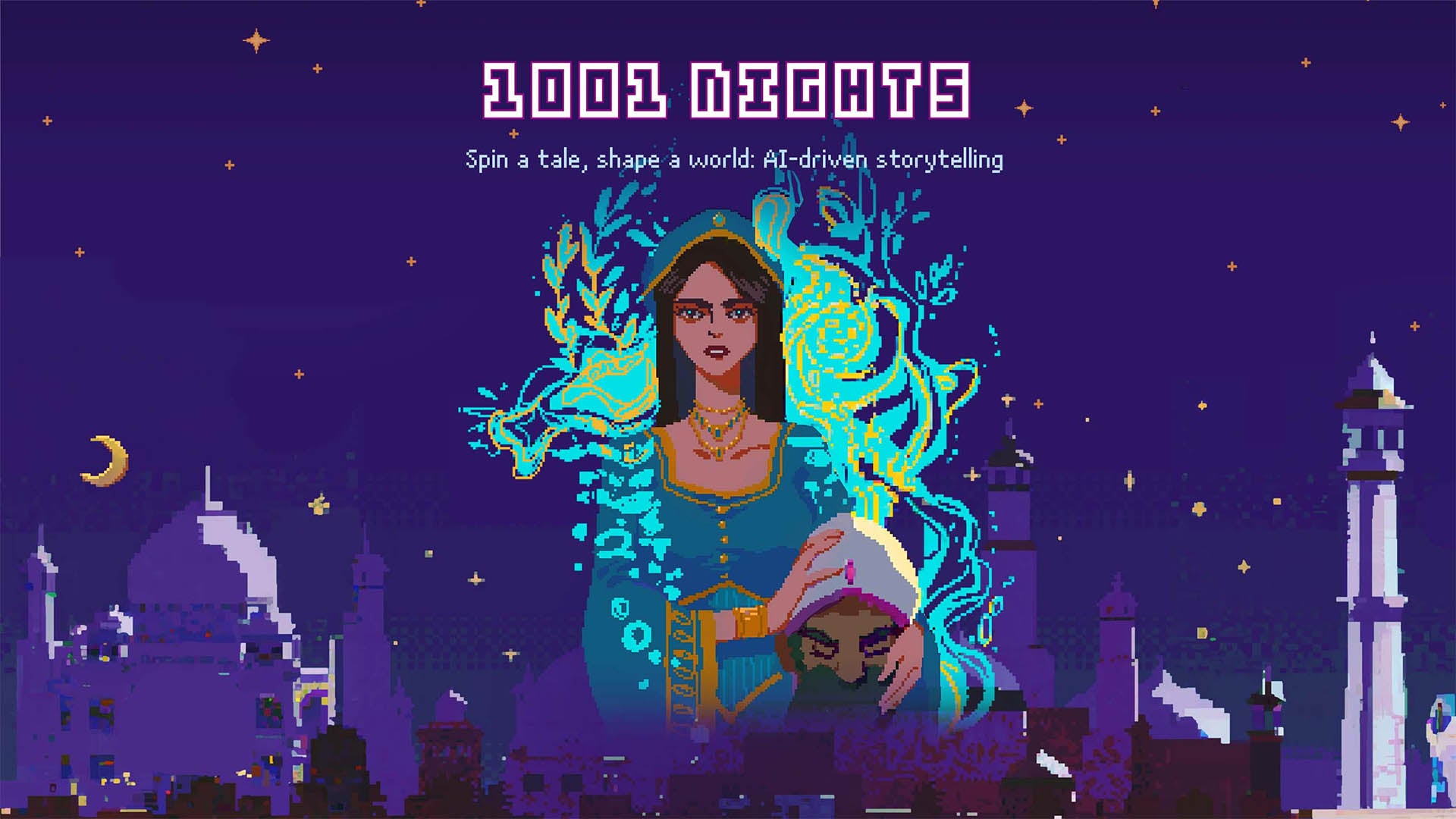
However additionally they consider LLMs might assist create new, fascinating experiences. They level to examples away from mainstream improvement: 1001 Nights is “designed round tricking the LLM-simulated character” into saying sure phrases.
“The designer did not simply drop LLM-based NPCs into a longtime sport style, she put a ton of design thought into arising with new handcrafted interactions across the LLM-based core gameplay loop.” Additionally they level to Infinite Craft, praised by RPS’ former critiques editor Ed Thorn, a crafting sport that makes use of an LLM to let gamers mix seemingly unrelated concepts.
Kreminski thinks there’s “an entire new class” of video games that could possibly be designed utilizing LLMs not as chatbots however as “interpreters of open-ended participant enter”.
In Façade, the 2005 interactive story created by Michael Mateas and Andrew Stern, gamers stroll round an condominium, kind no matter they need, and watch the sport reply. LLMs weren’t round then, “so Michael and Andrew needed to handcraft an excellent elaborate rules-based parser to make sense of those open-ended participant utterances”. It broke usually, however Kreminski nonetheless discovered the combo of scripted and improvised play compelling.
They’ll think about LLMs sitting as certainly one of many parts in a designer-led system that helps this Façade-style play. Success would look much more like “inventing a brand new sport style” than “augmenting an current one”, they are saying, earlier than ending like a consummate tutorial: “extra analysis is required”.
Dan Griliopoulos, author and narrative designer, previously of Inflexion Video games, Unbelievable, and Proxy Studios, shares the identical moral considerations round AI as his friends – together with vitality utilization, copyright and possession, the dangers of structural unemployment, and the distinction in values between CEOs and employees – however from a purely sensible perspective, he believes chatbots will develop into extra widespread and higher over the subsequent decade.
The place Winds Meet’s chatbots are “in a foul state”, he says: they’re too common, and break the fiction too usually. However he envisages narrative designers “curating” related chatbots and writing backstories, world histories, and personalities that feed into these NPCs, shaping their responses. These texts, he factors out, could possibly be written by AI, however “I would not essentially desire a chatbot to do this due to its tendency in the direction of the common. I wish to curate my world, I wish to make one thing unique and new.”
He acknowledges this might be a “cultural shift” from writing to curating, and it additionally requires programmers who can higher implement chatbots into video games in order that NPCs can react to participant decisions on the planet.
Massaging a chatbot’s voice to make it much less generic can be just like prompting an AI in your each day life, he says. “You’ll be able to say to it, write this within the fashion of a noir detective from the Nineteen Thirties, however keep inside our world, or, use an out-of-copyright or character voice, like Dickens, a personality from Bleak Home. And then you definitely might need one thing extra fascinating.”
Whereas his moral considerations are very actual, and speedy, he’s maybe a lick extra optimistic than others. “I am anxious in regards to the individuals whose careers can get worn out, and I am anxious in regards to the structural unemployment that comes with technological shifts. I am excited to reside sooner or later, and I am excited to play video games the place there are AIs who’re sensible sufficient to have discovered from the world and to react correctly to what I’ve achieved. It has been a dream for a very long time.”
And he additionally believes that the business must get up to the inevitability of genAI. In different sectors it’s getting used to make junior employees redundant and “we will not simply faux it isn’t going to occur”.
“As a substitute of getting these offended conversations about, how will we cease it, the conversations actually could possibly be extra productive. How will we retain jobs? How will we retain creativity? How will we keep away from these things being power-hungry and copyright-infringing? Can we make a model of this that we’re pleased with? Can we work in the direction of that? That dialog is not occurring as a result of the CEO class and everyone else is terrified of partaking with AI.”
When requested, he says cannot consider anyone doing these items proper in the intervening time.
“Should you maintain your self up as a flagship and go, we make all of these items ourselves, all the pieces is hand made, there are people who find themselves prepared to pay the additional worth for luxurious items”
– Dan Griliopoulos
One motive for optimism, he says, is that studios relying purely on human writers may extra starkly stand out. Gamers could even be prepared to pay extra for these video games, he says. “Should you maintain your self up as a flagship and go, we make all of these items ourselves, all the pieces is hand made, there are people who find themselves prepared to pay the additional worth for luxurious items,” he says.
“Going on the market and discovering the strangeness and discovering bizarre little edges that the AIs aren’t going to dig into, these are the bits of storytelling we will do higher nonetheless. They can not copy one thing if there’s nothing to repeat. So, discover the brand new tales, go and do your individual analysis, learn bizarre previous books, watch unusual movies from different nations, earlier than all of it turns into a mean block.”
To Younès Rabii, an indie developer and AI researcher, at present finding out for a PhD at Queen Mary College in London, the chatbot in The place Winds Meet seems like a “black field business business grade mannequin”: a “low-cost gimmick” that was by no means going to really feel coherent with the world. “It felt like, in a means, avoiding the work of writing dialogue for a sport and as an alternative externalising this work to a system that does not even appear tailored,” they are saying.
“There is a type of want achievement factor behind this expertise.”
– Younès Rabii
LLMs have some great benefits of generality and an enormous data base, however certainly one of their disadvantages, as seen in The place Winds Meet, is specificity. “There is a type of want achievement factor behind this expertise: I can say no matter and I’ll get a solution. However truthfully, you are able to do that with a cube. It doesn’t suggest that the reply is related to you. That is relevancy, that is precision. That is work that has been put in there by people.”
Rabii believes it’s theoretically doable to make a chatbot that’s related and tailored to a selected sport world, however it might take numerous work – human work. And at that time, you are going past an LLM chatbot to what’s successfully a procedural era system, they are saying.
“Say we now have a sport set in a selected period in China or evoking particular folktales and tales. We would like a genAI however we wish to prepare it on sources which can be from this period. Both historic sources that you’ve discovered and have translated, or texts that you’ve curated, cleaned and reformatted. Or, you are hiring writers who write new tales and eventualities that you simply wish to feed in. And all of this, it takes work and specificity. And this specificity is one thing that you simply do should pay for,” Rabii says.
“It is the price of analysis. It is the price of writing and all the pieces that’s behind writing a superb novel or a superb story. Should you keep away from paying these prices, why would you will have in any means some great benefits of them?”
The business, they are saying, must decelerate. We should first perceive the expertise, its limitations, its prices – together with a “catastrophic quantity of vitality” and creators not being paid for the work LLMs are educated on – after which “cultivate it”.
“It is not not possible that at some point AI programs can have a really fascinating voice that’s related and tailored, however behind it, people shall be placing within the work to make it possible for this voice is fascinating and related. And in a means will probably be their voice too, as a result of they will make choices in that system.”
Chris Gardiner, narrative director at Failbetter Video games, says it is easy to see the enchantment of LLM-powered chatbot NPCs. The “cynical enchantment”, he says, is value: squeezing essentially the most phrases from the fewest writers, which might in the end “manifest as layoffs and misplaced institutional data”.
However he additionally sees an idealistic enchantment. “The promise of the fully-immersive sport, the place you are able to do something and the world responds appropriately. Having the ability to speak to any NPC about any matter feels like an enormous step in the direction of that, proper?”
That preferrred – and the notion that LLMs transfer us in the direction of it – is misguided, he says, as a result of the product of writing will not be phrases however which means. “And generative AI can’t perceive which means, or perspective. It could actually’t have perception or appreciation. It could actually solely algorithmically guess at what you count on to listen to, with various ranges of success.”
Human writers could make the sort of deliberate decisions that AI chatbots cannot, he says, inflecting incidental NPC traces “to indicate one thing in regards to the sport’s society or latest occasions. They may add a joke, or tie it to the theme of the sport, or foreshadow a future occasion, or distinction one other piece of content material elsewhere. All of which provides to the richness of the sport.”
“[An LLM] does not perceive what a participant may need or want. It does not respect the participant sufficient to present them what they did not know they needed.”
– Chris Gardiner
AI chatbots do give gamers company of a kind: the liberty to say something to an NPC and get a response. It lets gamers go “off the rails”. However writers already reward gamers who wish to do that, he says. “Video games like Baldur’s Gate 3 allow their gamers to go off the rails in essentially the most wild, formidable methods, after which give that which means as a result of a human author hand-crafted a depraved or pleasant consequence to it.
“An LLM couldn’t, as a result of it does not have interiority, or motive, or a way of the broader and deeper truths of the sport’s world. It does not perceive what a participant may need or want. It does not respect the participant sufficient to present them what they did not know they needed.”
Extra extensively, he says, “even when I might put aside the moral points with generative AI that was scraped with out permission or cost from creators (I can’t) or the environmental penalties (I will not) and even the standard points (I don’t wish to) I nonetheless come again to the elemental query of ‘why’? Why would we wish much less of these issues I simply talked about in our artwork and our video games? Why have much less ingenuity and craft in them? We deserve video games that folks labored on with ardour.”

